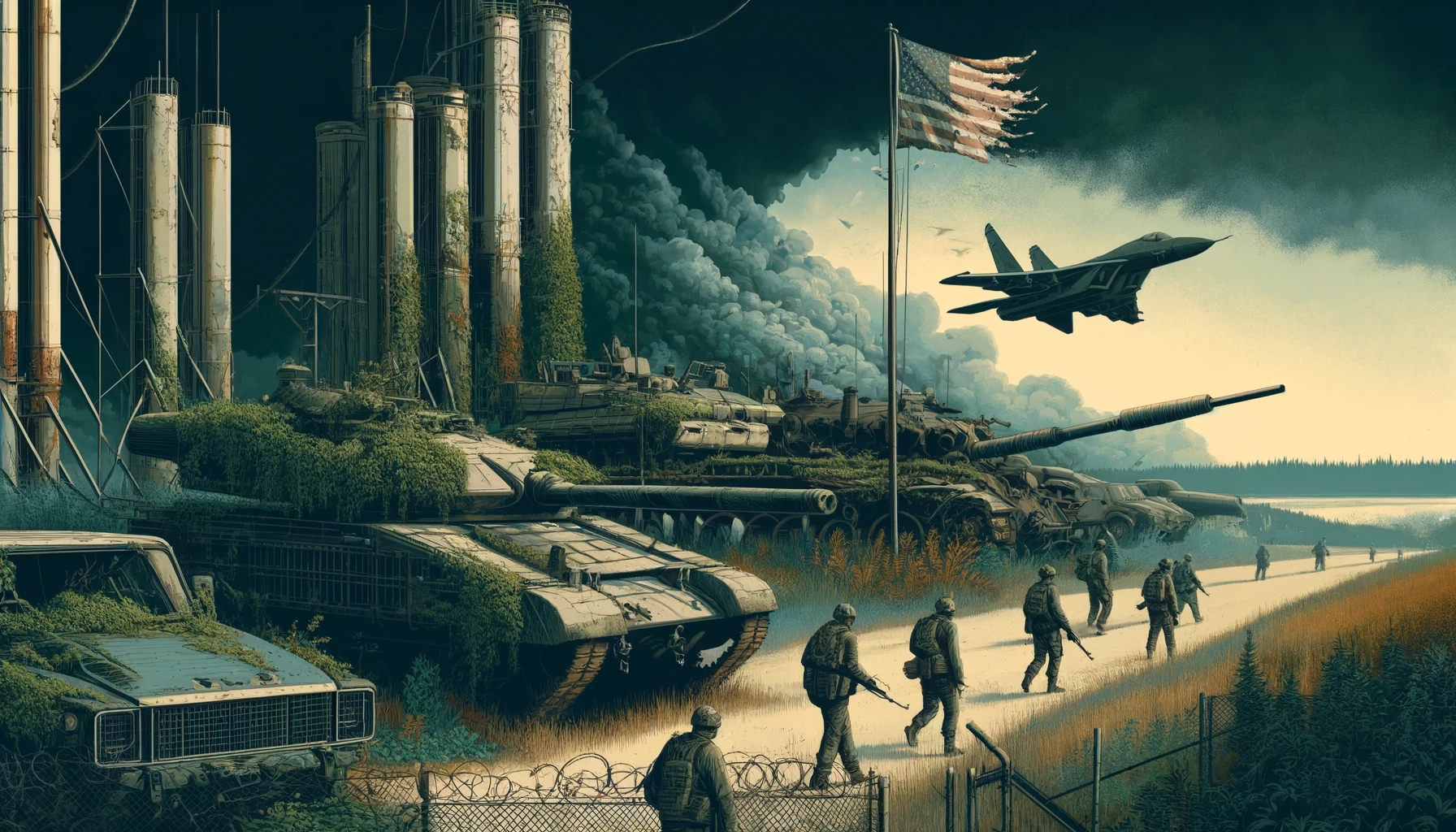
The impact of military overreach and overextension on the decline of the ‘Western Empire’ and western global dominance is a huge contributing factor to the global powershifts we see happening today. This overreach will have dramatic consequenses for the present as well as the future.
In the previous post, we explored the significant economic factors contributing to the decline of the modern Western Empire, including rising debt, financial instability, and the rise of new economic powers like China. However, economic burdens are only one facet of a more complex issue.
This post will transition to another critical aspect that also impacted the decline of the west: Military overreach and overtension
What is Military Overextension and Overreach?
OverExtension or Overreach forms a key part of what David Murrin calls the 5 stages of Empire.
As you read through his post you will see that the West shows all the signs of:
Stage 4 of Empire – Overextension: “The empire spends more than it earns, becomes less creative and starts to lose its moral authority.”
This can happen across a number of areas including militarily:
- Military overextension characterized by prolonged wars and a widespread global military presence, has been a recurring theme in the history of empires.
- Historical empires (e.g., Roman, British, Ottoman) all had phases where military overextension contributed to their decline.
- The cyclical nature of overextension and its consequences for hegemonic powers runs through history.
- It is essential to understand how this overextension is financially and strategically draining Western powers, ultimately contributing to their decline.
- The financial and resource drain of prolonged wars and maintaining a global military presence is substantial.
- The wars in Afghanistan and Iraq, for example, have been incredibly costly for the United States and its allies.
- These conflicts have not only drained financial resources but also led to significant human costs, including casualties and long-term health issues for veterans.
- Moreover, the maintenance of military bases worldwide adds to the economic burden.
- The U.S. alone has hundreds of military bases in various countries, each requiring significant funding for operations, personnel, and infrastructure.
- This widespread presence, while intended to project power and ensure security, also stretches the military’s capabilities and resources thin, making it challenging to respond effectively to emerging threats.
Weapons Don’t Come Cheap
As this overextension takes place, fighting wars and the purchasing of technological advanced military equipment have increased in cost:
- The modern military landscape is marked by technological and strategic challenges that are eroding traditional Western military superiority.
- The rise of new military technologies, such as drones, cyber warfare capabilities, and advanced missile systems, has changed the nature of warfare.
- These technologies are not only expensive to develop and maintain but also require continuous innovation to stay ahead of adversaries.
- China, in particular, has been making significant strides in military technology, including advancements in cybersecurity, biotechnology, and semiconductor manufacturing.
- These advancements pose a strategic challenge to Western military dominance, as they enable China to develop capabilities that can counter traditional Western military advantages.
Geopolitical Consequences of Overextension and Overreach
How Military Overreach Impacts Alliances and Global Influence
- Military overreach significantly strains alliances and erodes the geopolitical influence of Western powers, particularly the United States.
- Prolonged wars, unfulfilled promises, and inconsistent foreign policies create tension within traditional alliances, such as NATO and other security partnerships.
Key consequences include:
- Alliance Fatigue:
- Prolonged military commitments in regions like the Middle East and Afghanistan often lead to frustration among allies.
- The withdraw from Afghanistan instigated by President Trump and completed by President Biden showed an Empire in full retreat. A chaotic, scrambling and messy withdraw.
- Countries sharing the burden of these conflicts may feel disproportionately affected or undervalued, as seen in disagreements over burden-sharing within NATO.
- Loss of Trust and Credibility:
- Military misadventures, such as the Iraq War, damage Western powers’ credibility on the global stage.
- Perceived failures weaken the trust of allies, making it harder to rally collective action for future crises.
- Diverging Priorities:
- While Western nations may focus on containing perceived threats like China, allies in Europe or Asia may prioritize regional stability or economic growth over military posturing.
- This misalignment complicates joint strategies and weakens the cohesion of alliances.
- The Shifting Balance of Power Toward Emerging Nations
- The strain of military overreach has provided emerging powers like China, India, and Russia with opportunities to assert greater influence in global affairs. Key trends include:
China’s Strategic Rise:
While the West is preoccupied with managing multiple conflicts and maintaining a sprawling global presence, China has pursued a calculated strategy of economic and military expansion.
- Initiatives like the Belt and Road Initiative (BRI) extend China’s influence across Asia, Africa, and Europe, creating economic dependencies that strengthen its geopolitical clout.
- Simultaneously, China’s focus on modernizing its military and investing in technologies like AI and hypersonic weapons has enhanced its position as a global rival to the West.
India’s Growing Role:
As the world’s largest democracy and a rising economic power, India has increasingly asserted itself on the global stage.
- It is leveraging its strategic location and military modernization to emerge as a regional counterbalance to China.
- Meanwhile, India’s non-alignment policies enable it to engage with both Western powers and emerging blocs like BRICS, enhancing its influence in global decision-making.
Russia’s Opportunism:
While Western powers are stretched thin, Russia has exploited power vacuums to reassert influence in regions like Eastern Europe, the Middle East, and Africa.
- Its interventions in Syria, annexation of Crimea, invasion of Ukraine and involvement in Wagner-led operations in Africa exemplify its strategic use of limited military resources to challenge Western dominance.
Creation of Power Vacuums and Their Exploitation
Military overextension often leads to neglect of specific regions, leaving behind power vacuums that other nations or non-state actors are eager to fill. This trend accelerates the decline of Western influence and contributes to global instability:
- Middle East and North Africa:
- The withdrawal of Western forces from Iraq and Afghanistan has created opportunities for regional actors, such as Iran and Turkey, to expand their influence.
- Iran’s involvement in proxy wars and its partnerships with Russia and China challenge Western interests, while Turkey seeks to establish itself as a dominant regional power.
- Africa’s Strategic Realignment:
- As Western engagement wanes, countries like China and Russia have increased their presence in Africa through investments, arms deals, and infrastructure projects.
- China’s extensive involvement in African development and Russia’s military support to various regimes illustrate how power vacuums are being filled by non-Western powers.
- South America’s Shifting Dynamics:
- U.S. focus on other regions has allowed China to strengthen its influence in South America through trade partnerships and infrastructure investments.
- This undermines traditional U.S. dominance in its own hemisphere.
Long-Term Implications for Global Influence
The geopolitical consequences of military overextension are profound and multifaceted, leading to:
- Erosion of the Unipolar World Order:
- The United States and its allies are increasingly unable to dominate global affairs unilaterally, giving rise to a multipolar world where emerging powers exert significant influence.
- Diminished Leadership in Global Institutions:
- Western preoccupation with military commitments diverts attention and resources from leadership roles in global governance institutions, such as the UN and WHO, further diminishing their influence.
- Greater Regional Instability:
- Power vacuums created by overstretched Western powers lead to instability, enabling non-state actors like terrorist organizations and transnational criminal networks to thrive.
Fragmentation of Global Order
With an mainly on military action, the inability of overstretched Western powers to maintain their traditional roles as global stabilizers leads to a fragmented international order:
- Rise of regional blocs:
- Organizations like BRICS, the Shanghai Cooperation Organization (SCO), and ASEAN are gaining prominence as alternatives to Western-led institutions.
- These blocs often advocate for multipolarity, challenging the dominance of Western frameworks like the United Nations and the World Bank.
- Non-state actors filling gaps:
- Power vacuums also enable the rise of non-state actors such as terrorist organizations, insurgent groups, and transnational criminal networks.
- These entities thrive in regions where Western military efforts have waned, further destabilizing the global order.
- Diminished Leadership in Global Institutions:
- Western preoccupation with military commitments diverts attention and resources from leadership roles in global governance institutions, such as the UN and WHO, further diminishing their influence.
- Erosion of the Unipolar World Order:
- The United States and its allies are increasingly unable to dominate global affairs unilaterally, giving rise to a multipolar world where emerging powers exert significant influence.
The Erosion of Soft Power
Military overreach not only depletes financial and strategic resources but also significantly erodes the soft power that Western nations have relied on to maintain global influence.
- Soft power, defined as the ability to shape the preferences of others through attraction and persuasion rather than coercion, has been a cornerstone of Western dominance in the post-World War II era.
- However, aggressive foreign policies and prolonged military engagements have tarnished the moral authority and credibility of Western powers, weakening their ability to project influence through diplomacy, culture, and values.
Undermining Moral Authority
Military overreach, particularly in the form of unilateral interventions, has often been framed as contrary to the values of democracy, human rights, and international law that Western nations claim to uphold:
- Perceived Hypocrisy:
- Actions such as the invasion of Iraq in 2003, conducted without a clear UN mandate, have been widely criticized as violations of international norms.
- These actions have led to accusations of hypocrisy, as Western nations appear to disregard the very principles they advocate.
- Civilian Casualties and Collateral Damage:
- Prolonged wars, such as those in Afghanistan and Iraq, have resulted in significant civilian casualties, displacement, and destruction of infrastructure.
- These humanitarian crises have undermined the West’s image as a protector of human rights and global stability.
- Torture and Human Rights Abuses:
- Scandals such as the Abu Ghraib prison abuses and reports of torture in CIA black sites have severely damaged the West’s moral authority, providing ammunition for critics and adversaries to question the legitimacy of its global leadership.
Declining Trust in Global Institutions
- Undermining Multilateralism:
- Actions perceived as unilateral, such as the U.S. withdrawal from international agreements (e.g., the Paris Climate Accord, Iran Nuclear Deal), have raised concerns about the West’s commitment to collective problem-solving.
- UN and NATO Credibility:
- The bypassing or sidelining of institutions like the United Nations in favor of unilateral military actions has weakened their credibility. For instance, the Iraq invasion highlighted the inability of the UN to enforce compliance among powerful member states, leading to a loss of faith in the institution’s impartiality.
- Economic and Military Aid Controversies:
- Military aid to regimes with poor human rights records (e.g., Saudi Arabia during the Yemen conflict) has raised questions about the West’s commitment to justice and democracy, further alienating key global audiences.
Alienation of Allies and Partner Nations
Aggressive foreign policies driven by military overreach have often alienated traditional allies and partners:
- Strains on NATO and EU Relations:
- Disagreements over military engagements and defense spending have caused divisions within NATO. Many European allies were critical of the U.S.-led interventions in Iraq and Afghanistan, leading to reduced unity within the alliance.
- Loss of Influence in the Global South:
- Developing nations often view Western military actions as imperialistic, prioritizing geopolitical interests over the welfare of local populations. This perception has driven some nations in Africa, Latin America, and Asia to seek partnerships with alternative powers like China and Russia.
Empowering Alternative Narratives
Military overreach provides adversaries with the opportunity to shape global narratives that challenge Western leadership:
China and Russia as Alternatives: Both nations frequently portray themselves as champions of sovereignty and multipolarity, contrasting their approach with the West’s interventionist policies. These narratives resonate with nations seeking alternatives to Western dominance.
Soft Power of Non-Western Nations: China’s Belt and Road Initiative and Russia’s assertive diplomacy in conflict zones (e.g., Syria) highlight how these nations are leveraging their influence to fill the void left by waning Western soft power.
Examples of Declining Soft Power
Specific instances illustrate how military overreach has led to declining trust and influence:
- Iraq War (2003):
- The invasion of Iraq, justified by claims of weapons of mass destruction that were never found, led to widespread global disapproval.
- This severely damaged the U.S.’s credibility and strained relations with allies like France and Germany.
- Afghanistan Withdrawal (2021):
- The chaotic U.S. withdrawal from Afghanistan was seen as a failure of strategic planning, leading to criticism from allies and adversaries alike.
- It damaged perceptions of the West’s reliability and competence.
- Libya Intervention (2011):
- While initially framed as a humanitarian intervention, the NATO-led operation in Libya led to the toppling of Muammar Gaddafi without a clear post-conflict plan.
- The resulting instability has been cited as a failure of Western interventionism.
The erosion of soft power due to military overreach poses long-term challenges for the West.
While military strength remains a critical tool, the diminishing appeal of Western values, institutions, and leadership risks accelerating the global power shift toward a multipolar world.
To rebuild trust and influence, Western powers must prioritize diplomacy, multilateralism, and investments in soft power assets, balancing military commitments with a renewed focus on the principles they claim to represent.
The Decline of Cultural and Diplomatic Appeal
Soft power is also tied to cultural and diplomatic influence, which can be diminished by military overreach:
- Reduced Educational and Cultural Exchange:
- Perceptions of the West as overly militaristic discourage cultural exchange and diminish its appeal as a partner for education and innovation.
- Loss of Diplomatic Leverage:
- Countries skeptical of Western intentions are less likely to engage in trade agreements, partnerships, or other collaborative efforts.
Conclusion
- Military overextension is a critical factor in the decline of the modern ‘Western Empire’.
- The financial drain from prolonged wars and the maintenance of a global military presence, combined with the technological and strategic challenges posed by emerging powers, are weakening Western military capabilities.
- As we reflect on these issues, it is crucial to consider the long-term consequences of military actions.
- The continuous engagement in costly wars and the maintenance of a sprawling military presence are not sustainable in the face of rising economic and technological competition.
- As we can see military action and failure of the right action can also cause other long term global issues for the west including loss of trust and appeal.
Path Ahead
As we navigate these huge challenges, it is essential to reflect on the potential outcomes of our current military actions and inactions the west is curretnly taking. As we progress into the future technological advancements and shifts in global power as Empires rise and Empires fall increase the possibility of war and conflict.
Its also worth looking back to the beginning of the 20th Century to understand how history may just start to be repeating it’s self. https://nowistomorrow.com/1900-to-now-how-global-power-shifts-reshaped-the-world/
We urge our readers to think critically about these issues and their implications for the future.
Share Your Thoughts
We invite your feedback and thoughts on the role of military overextension in the decline of the west and the West as an Empire in decline.
Do you agree that the West is in the Stage 4 of Empire – Overextension?
How do you think Western powers can balance their military commitments with the need to address emerging economic, social, geopolitical and technological challenges?
Share your insights in the comments below.
Your perspectives are invaluable as we continue this series, exploring the military, ideological, and historical aspects of the decline of the modern Western empire.
In the next post, we will delve into the ideological influences that are shaping the global political landscape and contributing to the decline of the Western Empire. We will explore the rise of alternative ideologies, internal ideological divisions within Western countries, and how these shifts are impacting global politics.
Question and Answers
- Question and Answer 1
- Q: What is military overextension and how does it affect empires?
- A: These wars have been incredibly costly, draining financial resources and leading to significant human costs, including casualties and long-term health issues for veterans.
- Question and Answer 2
- Q: How have prolonged wars in Afghanistan and Iraq impacted the United States and its allies?
- A:Technological advancements, such as drones, cyber warfare capabilities, and advanced missile systems, have changed the nature of warfare, requiring continuous innovation to stay ahead of adversaries.
- Question and Answer 3
- Q: What role do technological advancements play in the modern military landscape?
- A:Technological advancements, such as drones, cyber warfare capabilities, and advanced missile systems, have changed the nature of warfare, requiring continuous innovation to stay ahead of adversaries.
- Question and Answer 4
- Q: How is China’s military technology advancement challenging Western military dominance?
- A:China’s advancements in cybersecurity, biotechnology, and semiconductor manufacturing enable it to develop capabilities that can counter traditional Western military advantages.
- Question and Answer 5
- Q: What are the long-term consequences of continuous engagement in costly wars for Western powers?
- A:The continuous engagement in costly wars is not sustainable in the face of rising economic and technological competition, weakening Western military capabilities and economic stability.
- Question and Answer 6
- Q: How can Western powers balance their military commitments with emerging economic and technological challenges?
- A:Western powers can balance their commitments by assessing financial impacts, evaluating strategic benefits, investing in innovative technologies, and engaging in international diplomacy to reduce the need for extensive military engagements.
- Question and Answer 7
- Q: What are some alternative approaches to security and defense that mitigate the risks of overextension?
- A: Alternative approaches include investing in diplomacy, developing alliances, and focusing on economic and technological development to enhance security without extensive military engagements.
- Question and Answer 8
- Q: How does the maintenance of global military bases contribute to the economic burden on Western powers?
- A: The maintenance of global military bases requires significant funding for operations, personnel, and infrastructure, stretching the military’s capabilities and resources thin.
References
https://www.ft.com/content/eb86f087-e1cc-4d98-98fa-3552f9b53b2e
https://www.weforum.org/stories/2024/05/why-geopolitics-matters-more-than-ever-in-a-multipolar-world
https://www.sipri.org/sites/default/files/2024-04/2404_fs_milex_2023.pdf
https://www.heritage.org/military-strength/executive-summary
https://www.realinstitutoelcano.org/en/commentaries/the-decline-of-the-west-1918-2018
https://www.thenation.com/article/world/global-security-nato-summit-crisis
https://www.csis.org/analysis/impact-ending-military-aid-ukraine-gradual-decline-then-collapse
https://www.chathamhouse.org/2021/03/war-time-temporality-and-decline-western-military-power
https://www.spglobal.com/en/research-insights/market-insights/geopolitical-risk
https://journals.sagepub.com/doi/10.1177/0095327X7500100201?icid=int.sj-abstract.similar-articles.6
https://www.davidmurrin.co.uk/breaking-the-code-of-history
#MilitaryOverextension, #WesternEmpireDecline, #EconomicBurden, #TechnologicalChallenges, #GlobalMilitaryPresence, #StrategicVulnerabilities, #ProlongedWars, #FinancialDrain, #HumanCosts, #InnovativeTechnologies, #InternationalDiplomacy, #SecurityAndDefense, #EconomicStability, #MilitarySuperiority, #EmergingPowers, #GlobalPolitics, #IdeologicalInfluences, #AlternativeApproaches, #LongTermConsequences, #WesternPowers
No responses yet